Who it’s for · Crypto and virtual currency
Deposits never stop, prices move, and five working days is not long. Quantoflow takes your transaction data by spreadsheet or API, works out which deposits need a report, and files each LVCTR, EFTR and STR with a receipt. If filing is all you need, Report is sold on its own.
Deposits arrive at all hours and at moving prices. Each has to be valued in Canadian dollars and counted toward the 24-hour total.
Fewer trades, larger amounts. One deposit can be an LVCTR, and paying out abroad can add an EFTR.
Stablecoins still have to be converted to Canadian dollars before you know whether a deposit is reportable.
A foreign MSB dealing in virtual currency for clients in Canada has FINTRAC reporting duties too.
Dealing in virtual currency makes you a money services business under the PCMLTFA. These are the reports to plan for. Amounts are in Canadian dollars, or the equivalent in another currency.
| Report | When you file it | Deadline |
|---|---|---|
| LVCTRLarge Virtual Currency Transaction Report | You receive virtual currency worth $10,000 or more from a client, at once or across 24 hours. | 5 working days after receipt |
| STRSuspicious Transaction Report | You have reasonable grounds to suspect a transaction, or an attempted one, is linked to money laundering or terrorist financing. Any amount. | As soon as practicable |
| EFTRElectronic Funds Transfer Report | You send, or finally receive, international transfers of $10,000 or more in fiat, at once or across 24 hours. | 5 working days after an outgoing transfer is sent, or after final receipt of an incoming one |
The 24-hour rule. Smaller deposits that reach $10,000 together within a 24-hour window, and share the same conductor, third party or beneficiary, are reported as one. Several wallets do not make several clients. How the 24-hour rule works
Sources: PCMLTFR s. 30: Money services business reporting obligations; FINTRAC: Reporting large virtual currency transactions to FINTRAC; FINTRAC: Reporting transactions to FINTRAC: The 24-hour rule; FINTRAC: Travel rule for electronic funds and virtual currency transfers.
Drag in the CSV or Excel export you already keep.
Approve, and the reports go straight to FINTRAC through its API.
Each filing returns a timestamped receipt, kept with the report.
Some platforms already monitor with another tool and need only their filings handled. Others want alerts, investigations and reports in the same place.
| What you get | Report on its ownFor platforms that monitor another way | Report + Monitoring + CasesFor platforms that work alerts and investigations in-house |
|---|---|---|
| Build, check and file LVCTRs, EFTRs and STRs | Included | Included |
| Spreadsheet upload and REST API | Included | Included |
| Direct filing, with a receipt for every report | Included | Included |
| Your own monitoring rules and a ranked alert queue | Not included | Included |
| Case files, open-source search and an investigation timeline | Not included | Included |
| AI STR narrative drafting | Add-on | Included |
| Unlimited users and multi-tenancy | Included | Included |
Start with Report. Monitoring and Cases are separate modules you can bring in later, without moving your data. Monitoring · Cases
You pay for the reports you file each year. Not for seats, and not for transaction volume.
Up to 1,200 reports a year (about 100 a month)
Starting at $599/month
Smaller MSBs and new registrants filing mostly threshold reports
Up to 12,000 reports a year (about 1,000 a month)
Growing MSBs, PSPs and crypto businesses with steady LCTR, EFTR or LVCTR volume
“The support Quantoflow provided is invaluable. We would not have been able to achieve this on our own no matter how much time we poured into it, and after consulting several external experts without success, The company delivered exactly what we needed in record time. Quantoflow’s assistance allowed us to avoid a costly escalation.”
A compliance firm that moved its clients’ STR and LVCTR filing off manual workflows and onto Quantoflow, with every client run from one account.
A Large Virtual Currency Transaction Report (LVCTR) when you receive $10,000 or more in virtual currency, and a Suspicious Transaction Report (STR) for any amount when you have reasonable grounds to suspect money laundering or terrorist financing. If you also move fiat across the border, international transfers are reportable on an Electronic Funds Transfer Report (EFTR) from $10,000. See the LVCTR guide.
No. The LVCTR covers virtual currency you receive. A suspicious withdrawal still has to be reported on an STR, whatever the amount.
Yes. FINTRAC’s guidance has money services businesses and foreign MSBs include the originator’s and beneficiary’s names, addresses and any account or reference numbers when they send virtual currency, and take reasonable measures to make sure it is included when they receive it. It is separate from reporting. More on the travel rule in practice.
Yes. Deposits that total $10,000 or more within a 24-hour window, and share a conductor, third party or beneficiary, are reported together. Quantoflow applies the rule to the data you upload. How the 24-hour rule works.
For fiat, the Bank of Canada rate where one is published. The Bank does not publish virtual currency rates, so there you use the rate you establish in the normal course of business, and document how. See exchange rates for FINTRAC reports.
FINTRAC requires foreign currency transactions to be converted to Canadian dollars using the Bank of Canada rate to test the $10,000 reporting threshold. Here is how that works, where the Bank of Canada data runs out, and how to handle unlisted currencies and stablecoins like USDC and USDT.
Read the article
FINTRAC fined Cryptomus $176.9M, its largest penalty yet, for AML violations that included failing to report suspicious transactions linked to child exploitation, fraud and sanctions evasion.
Read the article
The PCMLTFR 24-hour rule says cash amounts totalling $10,000 or more within 24 consecutive hours are a single transaction. FINTRAC guidance describes static windows, but a running clock can catch transactions a static window misses. What the law says, where the readings part, and how to choose a method.
Read the article
As the RPAA matures and FINTRAC looks harder at payment service providers, compliance teams face questions nobody has settled: two-leg reporting, Travel Rule data gaps, crypto transaction fields, and what to do when guidance lags behind practice.
Read the article
Using large language models to draft Suspicious Transaction Report narratives: what AI improves, where it invents or flattens, the confidentiality problem few plan for, and the division of labour that holds up under examination.
Read the article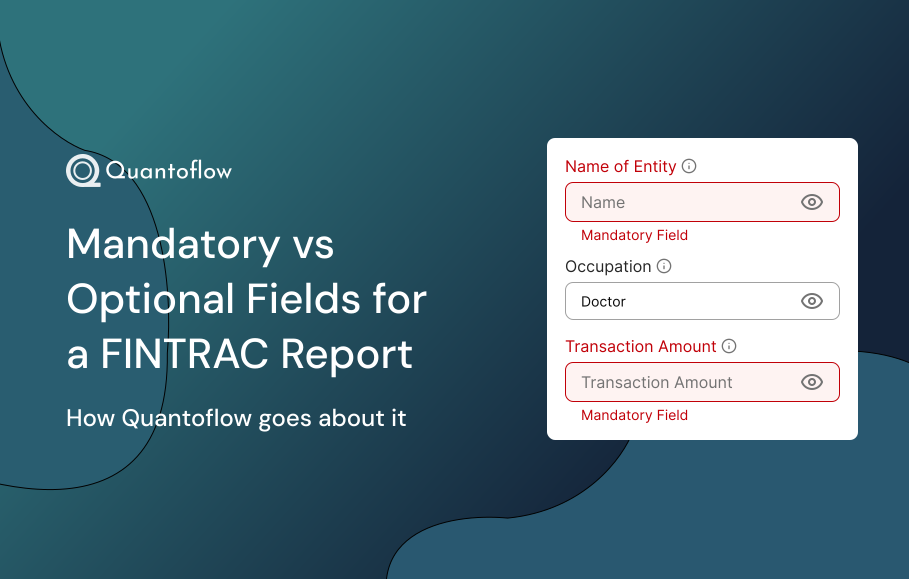
Which FINTRAC fields you must complete, which apply only sometimes, and which call for reasonable measures, with good practice for handling optional information in your reports.
Read the articleSee Quantoflow with your own reports in mind. Book a demo and we’ll show you where the hours go.
