Resources · FINTRAC reporting
The 24-hour rule requires a reporting entity to treat several transactions as one when they total $10,000 or more within a 24-hour window and are connected by the same person or entity. It exists so a client can’t avoid a report by splitting $15,000 into three smaller amounts.
Checked against FINTRAC’s guidance on October 15, 2026. Amounts are in Canadian dollars or the equivalent in foreign or virtual currency.
Transactions are reported together when all of these are true:
The transactions were carried out (or, for a transfer, requested) by the same person or entity.
The transactions were carried out on behalf of the same person or entity.
The transactions are for the same person or entity, whoever conducted them.
All the transactions that meet the rule go in the same report. Since June 1, 2021 that includes transactions of $10,000 or more: a single large transaction is only reported on its own if it can’t be aggregated with anything else in the window.
Every FINTRAC report with a $10,000 threshold. It does not apply to Suspicious Transaction Reports, which have no threshold.
Two or more cash amounts received that total $10,000 or more. FINTRAC’s current aggregation rules have applied to LCTRs since October 21, 2023.
Two or more amounts of virtual currency received that total $10,000 or more. Applied since June 1, 2021.
Two or more international electronic funds transfers initiated, or finally received, that total $10,000 or more. For an incoming transfer, the types are the same requester or the same beneficiary.
Two or more casino disbursements that total $10,000 or more, requested or received by, or on behalf of, the same person or entity.
FINTRAC’s 24-hour rule guidance was last updated in October 2023, when only the LVCTR and LCTR forms applied the current version of the rule. FINTRAC has since published dedicated guidance for electronic funds transfers and casino disbursements that sets out the 24-hour rule for those reports directly. Read it alongside this page.
FINTRAC uses a static window: you decide when it starts and ends, for example 9 am Monday to 8:59 am Tuesday, and every transaction belongs to exactly one window. You can set different windows for different business lines or transaction types, but each one must be written into your compliance policies and procedures, and the window’s start and end are a mandatory field on the report. Transactions at all of your locations count toward the same window.
A fixed window means two transactions minutes apart can land in different windows. The rule is still met, but your suspicious transaction monitoring should look across window boundaries. Static windows vs. running clocks
A client who deposits cash into their own account is both the conductor and the beneficiary, so the same transactions can qualify under two aggregation types. If two reports contain exactly the same transactions, you may submit just one of them, as long as your process for choosing is documented. If they overlap only partly, you must submit both.
For LVCTRs and EFTRs, aggregated amounts don’t have to be reported when the beneficiary (or, for an outgoing transfer, the requester) is a public body, a very large listed corporation or trust with at least $75 million in net assets, or a regulated pension fund administrator. The exception doesn’t cover any single transaction of $10,000 or more, which is still reported on its own.
Before June 1, 2021, only transactions under $10,000 were combined. Now a $12,000 transaction and a $3,000 transaction for the same client in the same window go in one report, rather than the $12,000 being reported on its own.
FINTRAC lets you choose when your 24-hour window starts, but it has to be fixed, written into your policies and procedures, and stated on the report. A team that applies “roughly a day” differently each time can’t show consistent aggregation.
Transactions at different locations in the same window still count together. A client who splits cash across two branches has to be caught across both.
If Bob conducts one transaction and someone else conducts a second on Bob’s behalf, Bob is the conductor in one and the third party in the other, so they don’t aggregate on Bob. They may still aggregate on a shared beneficiary.
Cash is aggregated with cash and virtual currency with virtual currency. A cash deposit and a crypto receipt by the same client are not added together for one report.
A transaction of $10,000 or more that is included in an aggregated report doesn’t also need a report of its own.
Aggregation depends on knowing two transactions involve the same person. If the same client appears under two IDs or two spellings, the rule can’t be applied, by software or by hand.
When you upload a transaction file, Quantoflow groups transactions by client within your configured 24-hour window and builds one report for each group that reaches $10,000. For that to work, each transaction needs a stable client identifier and a full timestamp, which your column mapping picks up from the export you already have.
The PCMLTFR 24-hour rule says cash amounts totalling $10,000 or more within 24 consecutive hours are a single transaction. FINTRAC guidance describes static windows, but a running clock can catch transactions a static window misses. What the law says, where the readings part, and how to choose a method.
Read the article
FINTRAC requires foreign currency transactions to be converted to Canadian dollars using the Bank of Canada rate to test the $10,000 reporting threshold. Here is how that works, where the Bank of Canada data runs out, and how to handle unlisted currencies and stablecoins like USDC and USDT.
Read the article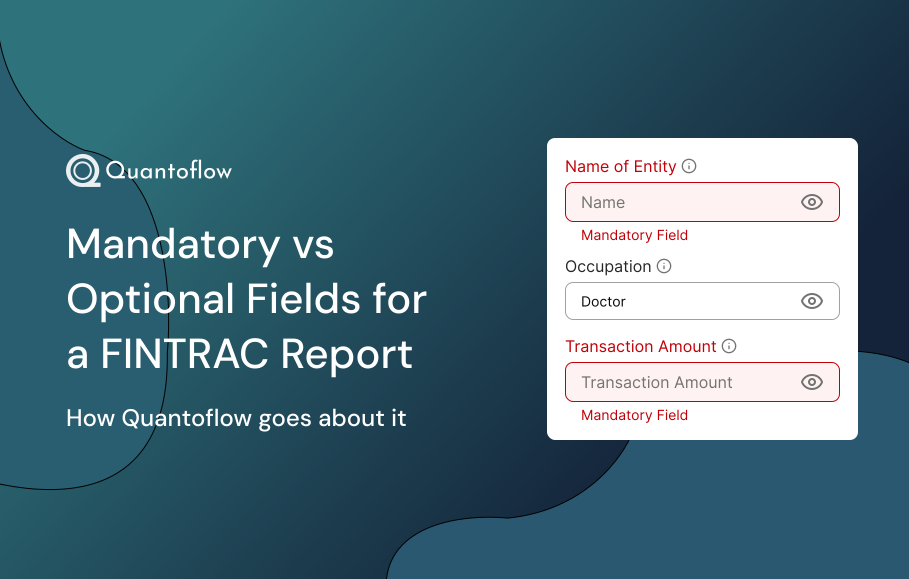
Which FINTRAC fields you must complete, which apply only sometimes, and which call for reasonable measures, with good practice for handling optional information in your reports.
Read the articleSee Quantoflow with your own reports in mind. Book a demo and we’ll show you where the hours go.
