Who it’s for · Money services businesses
An MSB files threshold reports week in, week out, usually from a spreadsheet and with a small team. Quantoflow takes the export you already have, builds the reports FINTRAC requires, and files them directly, with a receipt for each. If filing is all you need, Report is sold on its own. Users are unlimited and multi-tenancy is included, so a compliance firm can file for every MSB client from one account.
Cash over the counter, all day. Large cash and the 24-hour rule drive most of your filings.
Money in and out of the country. Every new corridor adds to your EFTR volume.
Cheques in, cash out. Thresholds and conductor details matter on every report.
Exchanges, brokers and crypto ATM operators, where $10,000 of virtual currency within 24 hours means an LVCTR.
Based abroad, serving Canadians, and bound by the same FINTRAC reporting rules.
Under the PCMLTFA regulations, an MSB reports these transactions to FINTRAC. Amounts are in Canadian dollars, or the equivalent in another currency.
| Report | When you file it | Deadline |
|---|---|---|
| LCTRLarge Cash Transaction Report | A client gives you $10,000 or more in cash, at once or across 24 hours. | 15 days from the date of cash receipt |
| EFTRElectronic Funds Transfer Report | You send, or finally receive, international transfers of $10,000 or more, at once or across 24 hours. | 5 working days after an outgoing transfer is sent, or after final receipt of an incoming one |
| LVCTRLarge Virtual Currency Transaction Report | You receive virtual currency worth $10,000 or more, at once or across 24 hours. | 5 working days after receipt |
| STRSuspicious Transaction Report | You have reasonable grounds to suspect a transaction, or an attempted one, is linked to money laundering or terrorist financing. Any amount. | As soon as practicable |
The 24-hour rule. Smaller transactions that reach $10,000 together within a 24-hour window, and share the same conductor, third party or beneficiary, are reported as one. It applies to large cash, international transfers and virtual currency, so it touches most MSB filings. How the 24-hour rule works
Sources: PCMLTFR s. 30: Money services business reporting obligations; FINTRAC: Reporting transactions to FINTRAC: The 24-hour rule.
Drag in the CSV or Excel export you already keep.
Thresholds checked, currencies converted, the 24-hour rule applied, and the reports you owe built.
Errors and duplicates are flagged, so you review only the exceptions.
Approve, and the reports go straight to FINTRAC through its API.
Each filing returns a timestamped receipt, kept with the report.
Some MSBs need only their filings handled. Others want to monitor and investigate in the same place. Choose the scope that fits how your program runs today.
| What you get | Report on its ownFor MSBs that monitor another way, or file mostly threshold reports | Report + Monitoring + CasesFor MSBs that work alerts and investigations in-house |
|---|---|---|
| Build, check and file LCTRs, EFTRs, LVCTRs and STRs | Included | Included |
| Spreadsheet upload and REST API | Included | Included |
| Direct filing, with a receipt for every report | Included | Included |
| Your own monitoring rules and a ranked alert queue | Not included | Included |
| Case files, open-source search and an investigation timeline | Not included | Included |
| AI STR narrative drafting | Add-on | Included |
| Unlimited users and multi-tenancy | Included | Included |
Start with Report. Add Monitoring and Cases later, without moving your data. Monitoring · Cases
You pay for the reports you file each year. Not for seats, and not for transaction volume.
Up to 1,200 reports a year (about 100 a month)
From $5,999 a year
Smaller MSBs and new registrants filing mostly threshold reports
Up to 12,000 reports a year (about 1,000 a month)
Contact us for pricing
Growing MSBs, PSPs and crypto businesses with steady LCTR, EFTR or LVCTR volume
“The support Quantoflow provided is invaluable. We would not have been able to achieve this on our own no matter how much time we poured into it, and after consulting several external experts without success, The company delivered exactly what we needed in record time. Quantoflow’s assistance allowed us to avoid a costly escalation.”
A compliance firm that moved its clients’ STR and LVCTR filing off manual workflows and onto Quantoflow, with every client run from one account.
Four. A Large Cash Transaction Report (LCTR) for $10,000 or more in cash. An Electronic Funds Transfer Report (EFTR) for international transfers of $10,000 or more. A Large Virtual Currency Transaction Report (LVCTR) for $10,000 or more in virtual currency. And a Suspicious Transaction Report (STR), for any amount, when you have reasonable grounds to suspect money laundering or terrorist financing. Each has its own deadline; see the FINTRAC report guides.
Yes. When an MSB receives two or more cash amounts or virtual currency amounts, or sends or receives two or more international transfers, that total $10,000 or more within a 24-hour window and involve the same conductor, the same third party or the same beneficiary, they must be reported together. How the 24-hour rule works.
Yes. At onboarding we map Quantoflow to the export you already keep. After that you upload it in the browser, review the exceptions and file, all within minutes.
About 100 reports a month is roughly 1,200 a year, which fits the Lite plan (up to 1,200 reports a year (about 100 a month)): From $5,999 a year. If you expect to grow past that, Standard covers up to 12,000 reports a year (about 1,000 a month). See pricing.
FINTRAC requires foreign currency transactions to be converted to Canadian dollars using the Bank of Canada rate to test the $10,000 reporting threshold. Here is how that works, where the Bank of Canada data runs out, and how to handle unlisted currencies and stablecoins like USDC and USDT.
Read the article
The PCMLTFR 24-hour rule says cash amounts totalling $10,000 or more within 24 consecutive hours are a single transaction. FINTRAC guidance describes static windows, but a running clock can catch transactions a static window misses. What the law says, where the readings part, and how to choose a method.
Read the article
Five years of FINTRAC enforcement show the same reporting failures behind record penalties. Which violations drew fines, and how to avoid them.
Read the article
FINTRAC fined Cryptomus $176.9M, its largest penalty yet, for AML violations that included failing to report suspicious transactions linked to child exploitation, fraud and sanctions evasion.
Read the article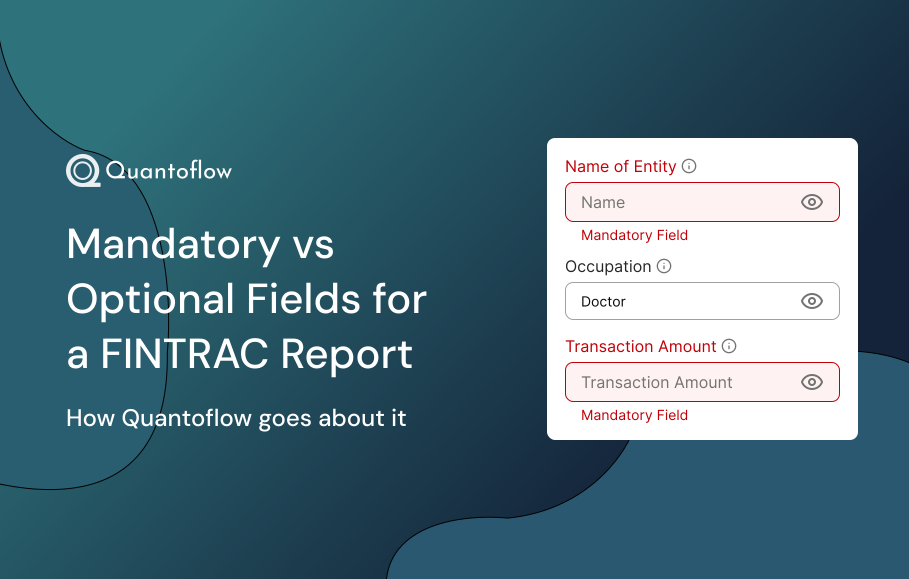
Which FINTRAC fields you must complete, which apply only sometimes, and which call for reasonable measures, with good practice for handling optional information in your reports.
Read the article
As the RPAA matures and FINTRAC looks harder at payment service providers, compliance teams face questions nobody has settled: two-leg reporting, Travel Rule data gaps, crypto transaction fields, and what to do when guidance lags behind practice.
Read the articleSee Quantoflow with your own reports in mind. Book a demo and we’ll show you where the hours go.
