You write the rules. Monitoring runs them, in real time or on a schedule, at the thresholds and windows your risk assessment calls for. Alerts arrive in a single queue, ranked by risk, with duplicates folded together and each score explained. Your analysts start with what matters most. Rule analytics close the loop: for each rule, how many alerts became cases, and how many cases became STRs. Keep the rules that earn their noise. Tune the rest. And when an examiner asks why your monitoring works the way it does, show them.
Set the threshold, the look-back window and the severity. Choose real time or a schedule. Match the typologies you actually face.
Follow each alert to a case and an STR. A rule that fires hundreds of times and never finds anything has nowhere to hide.
Alerts are scored and ordered. Related alerts become one piece of work. Each score shows the rules and activity behind it.
Every close has a reason on record. An alert worth investigating moves to Quantoflow Cases with its transactions attached.
See why an alert fired, who it involves and what moved. Then turn it into a case or close it with a reason, and every decision stays on record.
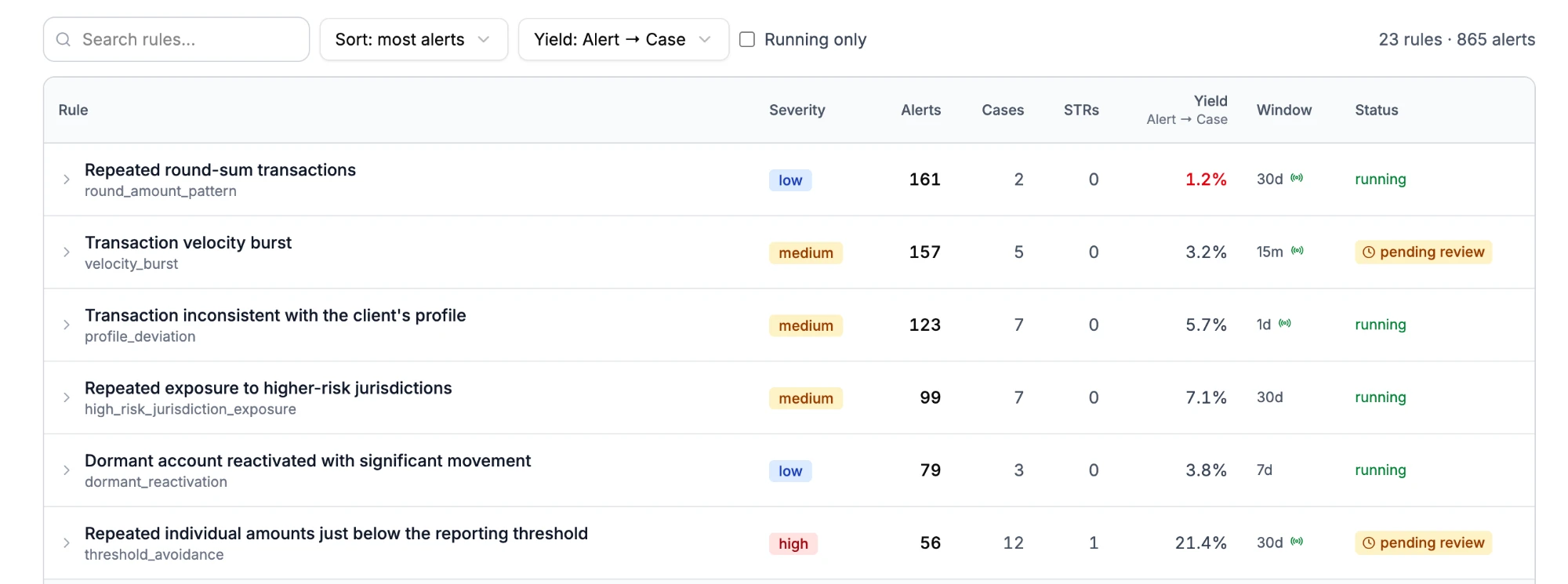
For each rule: its severity, its window, how it runs, how many alerts it raised, and how many of those became cases and STRs. Sort by volume or by yield, and the rules that make work without finding anything rise to the top.
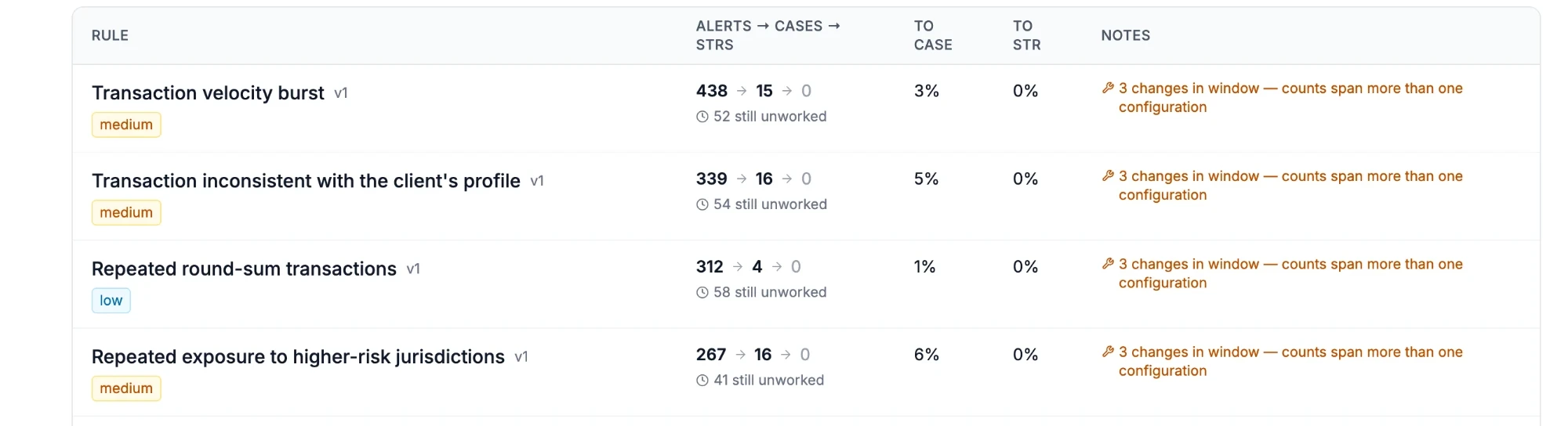
Trace each rule from alert to case to STR, see what remains unworked, and get a warning when a rule changed mid-period, so you never compare two configurations as if they were one.
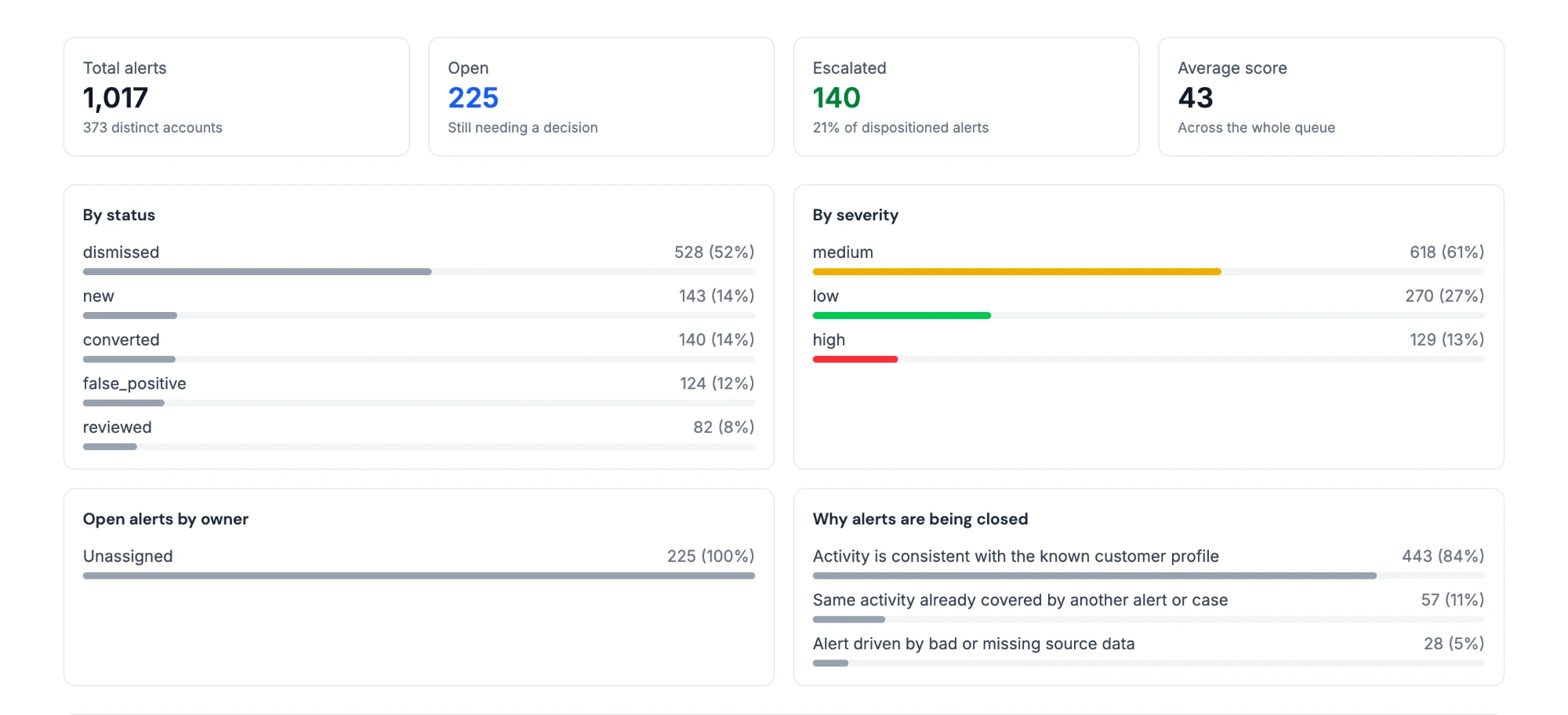
Open, escalated and dismissed alerts by status and severity; who owns what is open; and why alerts are being closed. When an examiner asks how decisions get made, this is the answer.
Money services businesses and other reporting entities under the PCMLTFA must monitor their business relationships on an ongoing basis. FINTRAC doesn’t require software for it. It does expect three things: that your monitoring follows your risk assessment, catches what must be reported, and survives an examiner’s questions. Here is how Monitoring meets each.
PCMLTFR s. 123.1
You must monitor your business relationships on an ongoing basis, at a frequency set by your documented risk assessment.
In Monitoring: Set each rule’s threshold, window and severity to the risks your assessment names, and run it in real time or on a schedule.
PCMLTFR s. 123.1(a)
That monitoring exists, in part, to catch the transactions you must report as suspicious, and an STR is due as soon as practicable.
In Monitoring: The queue is ranked by risk, so the likeliest STRs reach an analyst first. Those that warrant it move to Cases with their transactions attached.
STR filing guidePCMLTFR s. 156
Every two years your compliance program needs a documented review of its effectiveness, and examiners will ask how your monitoring is set up, and why.
In Monitoring: Each close has a recorded reason. Each score shows its rules. And each rule shows how many of its alerts became cases and STRs.
Statutory references are to the Proceeds of Crime (Money Laundering) and Terrorist Financing Regulations. General information, not legal advice.
No. The PCMLTFA regulations require ongoing monitoring of your business relationships, at a frequency set by your risk assessment. They don’t prescribe a tool. Software becomes the practical choice once volume outgrows manual review, and it makes your monitoring far easier to prove in an examination.
Yes. You set each rule’s threshold, look-back window and severity, and whether it runs in real time or on a schedule. Your rules follow your risk assessment, not ours.
Three ways. Alerts are ranked by risk, so the likeliest reports reach an analyst first. Related alerts merge into one review instead of five. And rule analytics expose the rules whose alerts never become cases, so you can tune them.
No. The rules and activity behind each score sit on the alert itself. Your analyst sees why it ranks where it does; your examiner sees why it was worked or closed.
The analyst escalates it to Quantoflow Cases, transactions attached. The investigation happens there, the STR narrative is drafted from the case file, and Quantoflow Report files it with FINTRAC as soon as practicable.
It gives you the evidence. A recorded reason for every close. An explanation for every score. And, rule by rule, how many alerts became cases and STRs. That is what an examiner, or your two-year effectiveness review, asks for.
Canadian reporting entities: currency exchanges, money transfer operators, virtual currency dealers and other money services businesses, payment service providers, and the compliance firms that work alerts for MSB clients.
Where FINTRAC's intelligence goes, how its enforcement cases end, and why your reports matter to law enforcement, border security and financial oversight in Canada.
Read the article
FINTRAC fined Cryptomus $176.9M, its largest penalty yet, for AML violations that included failing to report suspicious transactions linked to child exploitation, fraud and sanctions evasion.
Read the article
Five years of FINTRAC enforcement show the same reporting failures behind record penalties. Which violations drew fines, and how to avoid them.
Read the articleSee Quantoflow with your own reports in mind. Book a demo and we’ll show you where the hours go.
