Understanding FINTRAC's Intelligence Value and Enforcement Strategy
Every firm that reports to FINTRAC (the Financial Transactions and Reports Analysis Centre of Canada) sooner or later asks: what does it actually do, and what good does it do? It is a fair question, given how much homework FINTRAC sets with threshold reports and suspicious transaction reports. Here is the answer.
Intelligence Flow and National Impact
When a financial institution files a report with FINTRAC, the intelligence does not sit in a database. It goes to the agencies fighting financial crime on the ground.
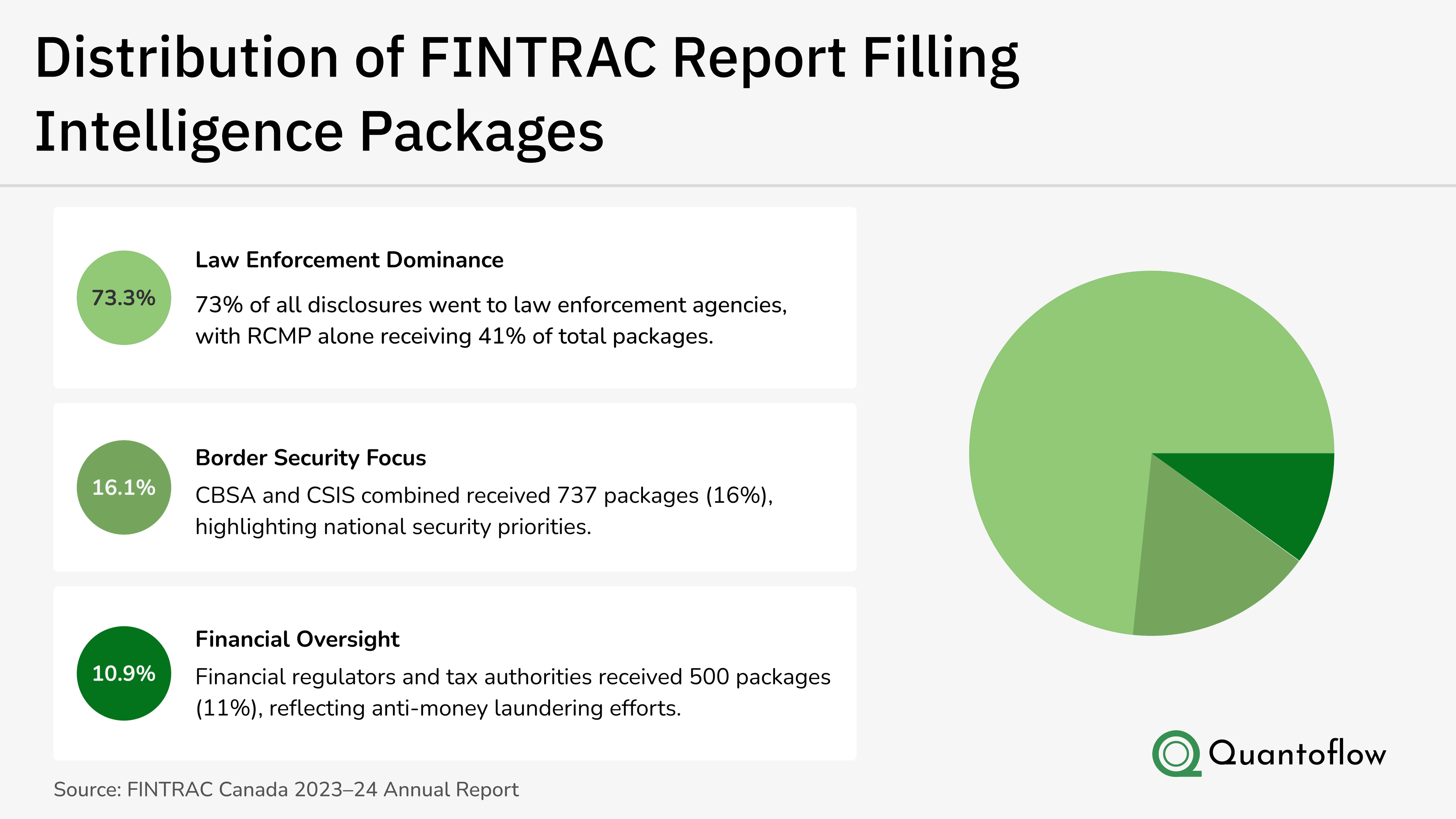
The numbers are clear: 73% of all intelligence packages go to law enforcement, and the RCMP alone receives 41%. That reflects FINTRAC's core mission, supporting criminal investigations into money laundering and terrorist financing.
Border and security agencies (CBSA and CSIS) receive 16% of packages, a sign of how much financial intelligence matters to national security. Cross-border flows, sanctions evasion and threat finance all lead to disclosures to these agencies.
Financial regulators and tax authorities account for 11%, so FINTRAC intelligence serves regulatory enforcement and tax compliance as well as criminal prosecution.
For reporting entities, the lesson is simple: your FINTRAC submissions have real effects. Any STR, LCTR or EFT report you file could become key evidence in a criminal investigation, a national security operation or a regulatory action.
The Role of Financial Intelligence
FINTRAC does more than enforce regulations. It is an intelligence hub for Canada's security agencies, and its 2023-24 Annual Report shows where its intelligence packages go.
Law Enforcement
73.3% of intelligence disclosures go to law enforcement agencies, with the RCMP receiving 41% of all packages. FINTRAC is a working partner in criminal investigations.
Border Security
16.1% of packages went to CBSA and CSIS, a substantial contribution to national security and the integrity of the border.
Financial Oversight
10.9% of packages support financial regulators and tax authorities in their anti-money laundering and compliance work.
FINTRAC stands between financial institutions and law enforcement, and passes what one knows to the other.
Enforcement Patterns and Outcomes
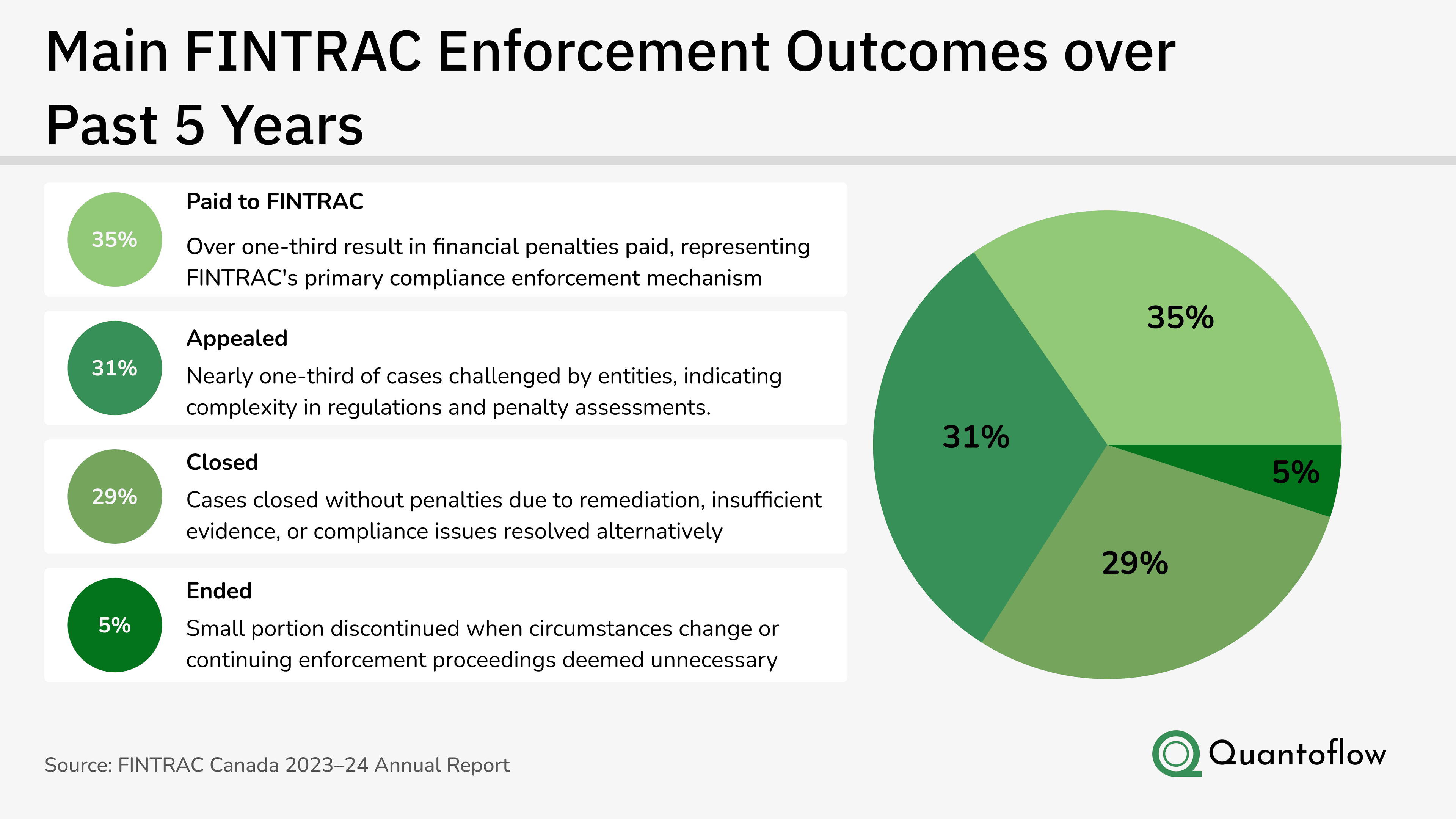
FINTRAC cases end in different places. The chart below shows the outcomes for companies fined by FINTRAC for non-compliance.
Analysis of Enforcement Distribution
Key Statistics
- 35% result in monetary penalties
- 31% of cases are appealed
- 29% closed without penalties
- 5% enforcement proceedings discontinued
What This Means
The high appeal rate suggests:
- Disagreement with penalty assessments
- Regulations that are hard to interpret
- A need for better compliance records
- The value of proper legal preparation
Organizations under FINTRAC oversight should be ready for penalties, and also for long proceedings if a case goes to appeal. With so many cases appealed, detailed compliance records matter, as does being ready to defend your practices and procedures.
Strategic Implications
Future of FINTRAC Compliance
Where to Focus
Financial institutions operating in Canada should put first:
- Sound compliance programs
- Suspicious transaction reporting systems
- Documentation and record-keeping
- Staff training and awareness
Important Reminder
FINTRAC identifies suspicious transaction reporting as "critical to FINTRAC's ability to generate actionable financial intelligence". With proposed penalty increases and enhanced regulatory powers on the horizon, the cost of non-compliance is set to rise dramatically in the coming years.
Where FINTRAC's intelligence goes shows that compliance is about more than avoiding penalties. It is a contribution to national security and to the work of law enforcement.
Citations
- FINTRAC 2023-2024 Annual Report https://fintrac-canafe.canada.ca/publications/ar/2024/ar2024-eng.pdf