Why Is My FINTRAC Registration Taking So Long?
The Only Number FINTRAC Publishes
If you are waiting on a registration or a renewal and hearing nothing, you are not being singled out. There is exactly one processing figure FINTRAC publishes, and it appears on both the registration and the renewal pages:
FINTRAC's published processing time
“The majority of complete applications are processed within three months from the receipt of a complete application package. More complex applications may take longer.”
Two words in that sentence carry all the weight: majority and complete. There is no published average, no median, and no maximum. "More complex applications may take longer" is the whole of the guidance for everything outside the majority.
Most of the frustration people describe comes from assuming the three months started when they hit submit. Usually it did not.
Your Clock Starts at Complete, Not at Submitted
FINTRAC is explicit that it only accepts complete applications. The three-month window runs from receipt of a complete package, which means an application missing information has not started the clock at all — it is sitting in a queue waiting to be made complete.
The mechanism FINTRAC uses to fix that is the clarification request:
A clarification request is a method used to communicate with money services businesses (MSBs) or foreign money services businesses (FMSBs) when FINTRAC needs more information about their registration form.
It is sent, in FINTRAC's words, when "information is inconsistent or cannot be adequately verified", usually by email to the contact person or representative for service on file. Three things about it matter more than most registrants realise:
- You have 30 days to respond. Not "promptly" — a hard 30-day count.
- Your delay is added to the total. FINTRAC states plainly that "delays in responding to clarification requests may increase overall processing times."
- Not answering is a ground for revocation. It is listed first among the reasons FINTRAC can deny or revoke, ahead of ineligibility.
That last point is the one worth sitting with. A clarification request is not administrative back-and-forth. It is a deadline with your registration attached to it, and it arrives by email to whatever address you listed — which may be a departed employee or an unmonitored inbox.
The Renewal Trap
Registration lasts two years, and FINTRAC's wording on renewal leaves no ambiguity about who owns the deadline:
FINTRAC on renewal
“Your registration is valid for two years. You must renew your registration before its expiry date. It is your responsibility to make sure your registration is renewed on time.”
There is one genuinely useful protection, and it is easy to miss: a business that submits its renewal before expiry "remains registered with FINTRAC until its renewal is processed." File in time and a slow review does not push you out of the registry.
Miss the date and there is no such grace. The registry's own definition of "Expired" is blunt — "a business that did not renew its registration after 2 years" — and FINTRAC warns that failure to renew "may result in administrative monetary penalties or criminal charges."
The same 30-day discipline applies to keeping your record current. If your contact person, representative for service, agents, locations or activities change, you must tell FINTRAC within 30 days. If you stop offering MSB services, you must cease the registration within 30 days.
What the Registry Actually Shows
FINTRAC publishes the whole Money Services Business Registry as a downloadable export, updated monthly. Counting it directly is more informative than any estimate:
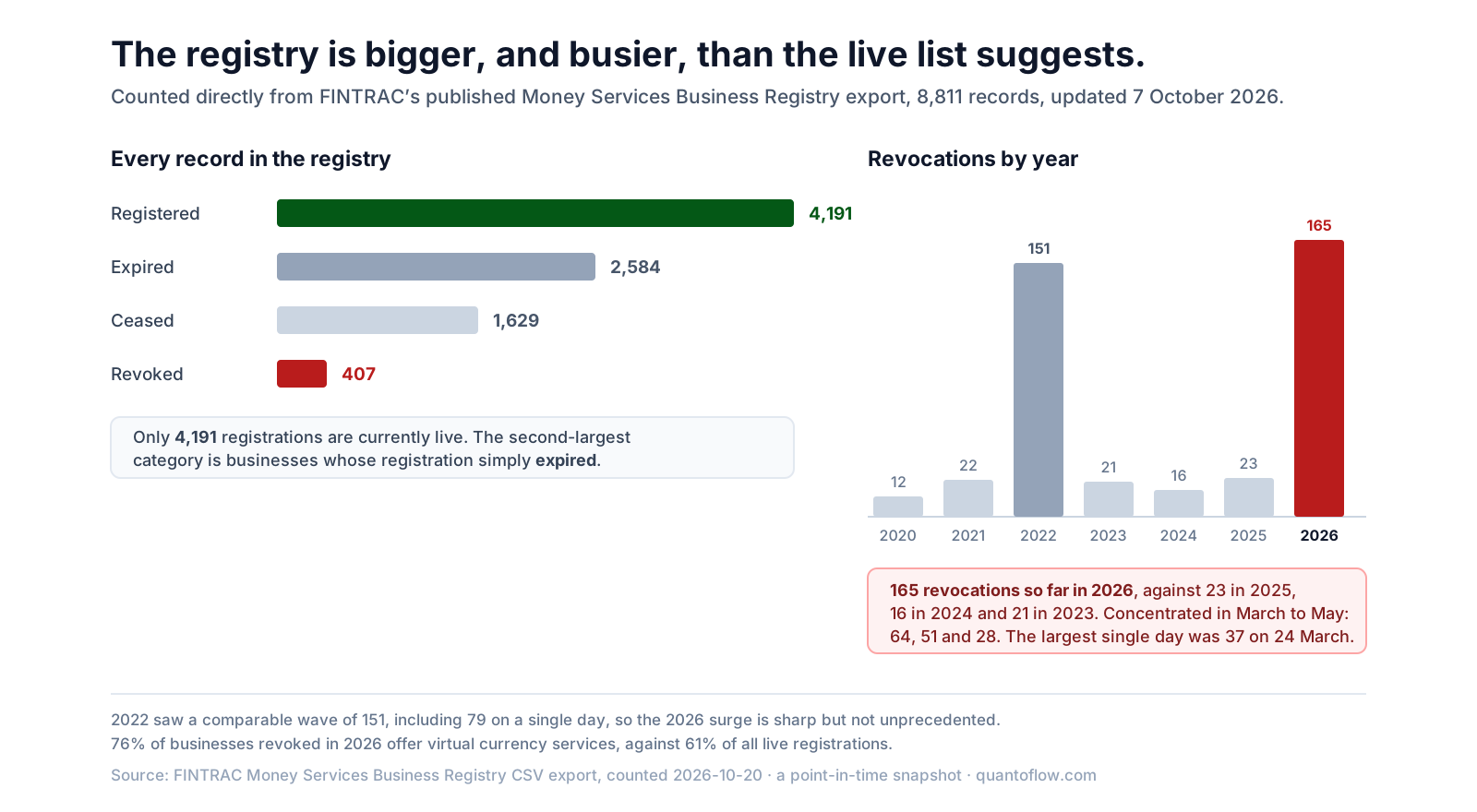
Two things stand out.
The live list is smaller than the registry. Of 8,811 records, only 4,191 are currently registered. The second-largest category is not ceased businesses or revoked ones — it is 2,584 expired registrations, businesses that were registered and then simply did not renew in time. Expiry, not enforcement, is the most common way to fall off the list.
The renewal load is constant. Because registrations run on a two-year cycle, roughly 60 to 110 of those 4,191 come up for renewal every single month. That is a steady background queue of some 900 renewals a year sitting alongside new applications, which is worth remembering when you are wondering what else FINTRAC could possibly be working on.
What Changed in 2026
This is the part that has people talking, and the registry data is unambiguous about it. 165 registrations have been revoked so far in 2026, against 23 in 2025, 16 in 2024 and 21 in 2023 — roughly seven times the recent annual rate.
They did not arrive evenly. March, April and May account for 143 of the 165, with the largest single day being 37 revocations on 24 March 2026.
Keep it in proportion
2026 is the sharpest year in the registry, but it is not without precedent: 2022 saw 151 revocations, including 79 on a single day in January. Reporting that treats 2026 as unprecedented is overstating it. What is fair to say is that the quiet years of 2023 to 2025 were the anomaly, not the baseline.
Virtual currency businesses are over-represented but not exclusively targeted: 76% of the 2026 revocations offer virtual currency services, against 61% of all live registrations. That is a real skew, and well short of the near-total figures circulating in some commentary.
As for why the registry has become more demanding, one change is worth knowing about. Requirements to verify the eligibility of agents and mandataries acting for an MSB came into force on 1 October 2025, with criminal record check obligations attached, and businesses have until 1 October 2027 to bring existing agents into compliance. If your registration involves an agent network, there is materially more for FINTRAC to verify than there was two years ago — and materially more for you to get inconsistent.
What Actually Shortens It
Nothing here makes FINTRAC faster. It makes your application less likely to be the one that is not in the majority.
- Renew early, not on time. Submitting before expiry keeps you registered while it is processed. Start 60 to 90 days out, and do not rely on a reminder arriving.
- Treat the contact email as critical infrastructure. Clarification requests go to the contact person or representative for service on file. A stale address is how a 30-day clock runs out without anyone seeing it.
- Answer clarification requests immediately, not on day 29. Your response time is added to the processing time, so the 30 days are a deadline, not an allowance.
- Reconcile before you submit. Inconsistency is the stated trigger. Legal name, operating names, incorporation number, addresses, listed activities and agents should match your corporate records and each other before the form goes in.
- Treat the 30-day update rule as standing. Changes of contact, representative, agents, locations and activities all carry it, and an out-of-date record is both a penalty exposure and a source of future inconsistency.
- Diarise the two-year date on the day you are approved. Of everything in the registry, expiry is the single most common failure, and it is the most avoidable.
The Bottom Line
Three months is a target for the majority of complete applications, and most of the waiting people experience happens before that window starts. The lever you control is completeness: a consistent application, a monitored contact address, and a clarification request answered in days rather than weeks.
The 2026 revocation wave adds a second reason to care. Not answering a clarification request is the first-listed ground for revocation, and 165 businesses have come off the register this year. An unmonitored inbox is now a genuine operational risk rather than an administrative untidiness.
Keep the obligations that follow registration
Registration is the start. Quantoflow Report files your FINTRAC reports with a full audit trail, Monitoring ranks the alerts that feed them, and Cases holds the investigations behind them.
Talk to the Quantoflow TeamCitations
- FINTRAC: Respond to clarification requests, update, renew or cancel your registration https://fintrac-canafe.canada.ca/msb-esm/register-inscrire/respond-eng
- FINTRAC: Register a money services business https://fintrac-canafe.canada.ca/msb-esm/register-inscrire/reg-ins-eng
- FINTRAC: Money Services Business Registry https://fintrac-canafe.canada.ca/msb-esm/reg-eng
- FINTRAC: Money services businesses https://fintrac-canafe.canada.ca/msb-esm/msb-eng
- PCMLTFA s. 11.1-11.2: Registration requirement and revocation https://laws-lois.justice.gc.ca/eng/acts/P-24.501/