SAR vs. STR: What Changes When You File in Both Jurisdictions
Two Regimes, Not One Report Filed Twice
A Canadian money services business signs its first US customers. A US business starts serving Canadians. Either way, the compliance team wakes up reporting to two financial intelligence units: FINTRAC in Canada and FinCEN in the United States.
The instinct is to treat this as one obligation with two addresses. File the suspicious report, send a copy north and a copy south, done.
That instinct is wrong, and it is expensive. A Suspicious Transaction Report (STR) and a Suspicious Activity Report (SAR) are not the same report in two accents. They have different triggers, different dollar floors, different clocks, different confidentiality rules, and — the one that catches teams out most often — different rules for deciding when two transactions are really one.
This post covers what actually changes, where the two regimes diverge in ways that alter the outcome, and why the filing flows should stay separate even when the underlying activity is identical.
The Suspicion Report: STR vs. SAR
Both regimes require you to report activity you find suspicious. They define the trigger differently.
| Canada · STR | United States · SAR | |
|---|---|---|
| Legal basis | PCMLTFA s. 7 | 31 CFR 1022.320 (MSBs) |
| Trigger | Reasonable grounds to suspect a transaction is related to money laundering or terrorist financing | Known or suspected illegal activity, BSA evasion, or a transaction with no apparent lawful purpose |
| Dollar floor | None | $2,000 for MSBs; $5,000 for banks (with exceptions) |
| Deadline | As soon as practicable after you determine grounds exist | 30 calendar days from initial detection |
| Filed through | FINTRAC Web Reporting or batch | BSA E-Filing System |
| Retention | 5 years | 5 years, with supporting documentation |
Two differences in that table do real work.
Canada has no dollar floor. A suspicious $400 transfer is reportable in Canada. In the US, an MSB's SAR obligation generally starts at $2,000. If you run one global suspicion queue with a $2,000 minimum baked into it because that is what your US process needed, you are under-reporting in Canada — and under-reporting an STR is a serious violation with an administrative monetary penalty reaching into the millions, on top of being a criminal offence under PCMLTFA s. 75.
The triggers are not synonyms. Canada asks whether there are reasonable grounds to suspect a link to money laundering or terrorist financing specifically. The US formulation is broader in subject matter — it reaches any known or suspected illegal activity, plus transactions designed to evade the BSA, plus transactions with no apparent lawful purpose. Activity can clear one bar and not the other in both directions.
Two Clocks With Opposite Failure Modes
This is the difference most likely to produce a finding, because the two deadlines fail in opposite ways.
The same delay, judged two different ways
Canada: file as soon as practicable after you complete the measures that established reasonable grounds to suspect. There is no day count. The longer you take, the better your explanation needs to be.
United States: file within 30 calendar days of initial detection of the facts that may constitute a basis for filing. The count can extend to 60 days where no suspect has been identified.
Canada's standard has no finish line to aim at, which means a team that files on day 25 every time is not automatically safe. If the file sat untouched for three weeks after the analyst already had grounds, "as soon as practicable" has not been met regardless of what the calendar says. FINTRAC's guidance treats the report as something to prioritise once grounds exist.
The US standard is the mirror image: it is a hard count, and it starts at initial detection, not at the moment the investigation concludes. Teams routinely start the clock when the analyst finishes the case. That is the wrong start point and it quietly eats the margin.
Practically, this means you cannot run one SLA. A single "file within 30 days" rule satisfies the US and can breach Canada. A single "file immediately" rule satisfies Canada and wastes nothing in the US — which is why, if you are going to run one standard, run Canada's. Just do not let that be an accident.
The Aggregation Trap
The threshold reports — Canada's LCTR and the US Currency Transaction Report — look like twins. Both are about cash. Both use $10,000. They are not twins, because they slice time differently.
Canada's 24-hour rule deems cash amounts totalling $10,000 or more, made within 24 consecutive hours, to be a single transaction (PCMLTFR s. 126). The US aggregates currency transactions per business day (31 CFR 1010.313), with the report triggered by more than $10,000.
Those two framings produce different answers on the same facts:
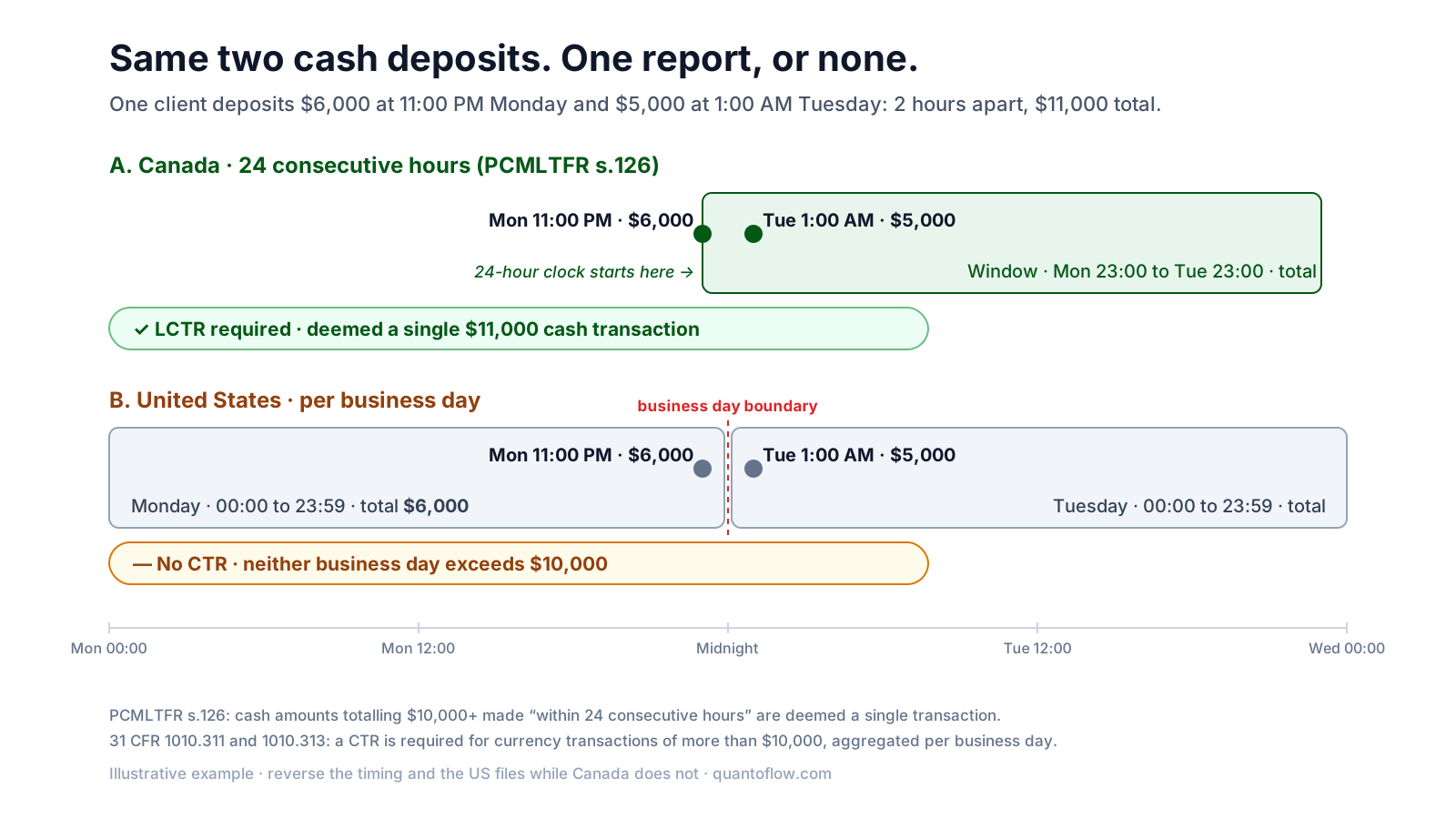
Reverse the timing and the divergence flips: two deposits at 9:00 AM and 4:00 PM on the same Monday total $11,000 in one business day, so the US files — and Canada files too, because they also fall within 24 consecutive hours. The regimes agree when activity sits inside a single day and part company at the boundaries.
Why this is not a rounding error
The transactions most likely to straddle a boundary are the ones someone placed there deliberately. Structuring targets exactly these seams. A monitoring rule written for one jurisdiction's time-slicing will systematically miss the other's.
There is a second difference worth noting: the US threshold is more than $10,000, while Canada's rule is triggered at $10,000 or more. A single $10,000.00 cash deposit is reportable in Canada and is not a CTR in the US. One cent decides it.
Continuing Activity Has No Canadian Twin
US practice includes a convention Canada does not share. Where suspicious activity continues after a SAR has been filed, FinCEN's guidance contemplates reporting that ongoing activity in a further SAR, reviewed on a roughly 90-day cycle.
Canada has no equivalent scheduled re-report. The STR obligation is triggered afresh each time there are reasonable grounds to suspect a transaction — which can mean more frequent filings than the US cadence, or fewer, depending entirely on the activity rather than on a calendar.
Teams running a single case-management workflow often implement the 90-day review globally and treat it as sufficient for both. It is not a Canadian obligation, and meeting it does not demonstrate that each Canadian transaction was reported as soon as practicable.
Confidentiality: Broad in the US, Narrower in Canada
Both regimes prohibit tipping off. The prohibitions are not the same shape, and the difference matters for what your staff are allowed to say.
A SAR, and any information that would reveal its existence, is confidential under 31 U.S.C. 5318(g)(2). There is no intent element. The statute also provides a safe harbour from civil liability for making a report, at 5318(g)(3), which courts have read broadly.
PCMLTFA s. 8 prohibits disclosing that a report under s. 7 has been, is being, or will be made, or disclosing its contents, with the intent to prejudice a criminal investigation. The intent element narrows the provision on paper.
In practice, do not treat Canada's intent element as headroom. It is difficult to explain why a client was told about a suspicious transaction report in a way that does not look like prejudicing an investigation, and the safer operating rule — one disclosure standard, the stricter one, applied everywhere — costs nothing.
What This Means for How You Build
The temptation when you report in two jurisdictions is to build one form, one queue and one deadline, with a country field. Every difference above is a reason not to.
- Keep the filing flows separate. The reports go to different regulators, through different channels, in different formats, on different clocks. A merged form inherits the weakest version of each rule and makes it impossible to show an examiner which obligation a given filing satisfied.
- Aggregate twice. Run Canadian aggregation on 24 consecutive hours and US aggregation per business day, over the same transaction data. One pass cannot produce both answers.
- Store full timestamps, with time zone. You cannot evaluate a 24-consecutive-hour window, or prove a business-day boundary, from dates alone.
- Separate detection time from decision time. The US clock starts at initial detection; Canada's starts when you complete the measures that establish grounds. Record both, for every case, or you cannot demonstrate either deadline was met.
- Set the suspicion floor to zero, then filter up. No Canadian dollar threshold means the queue should capture everything and apply the US $2,000 floor only to the US branch.
- Keep one evidence trail per case, two filings. A single investigation can legitimately produce an STR and a SAR. The case file should show one analysis and two distinct reporting decisions, each with its own rationale and timestamp.
The Bottom Line
Reporting in both jurisdictions is not twice the work of reporting in one — it is different work. The suspicion thresholds do not line up, the clocks fail in opposite directions, and the aggregation rules disagree precisely at the boundaries that structuring targets. A team that builds one merged process will satisfy neither regulator cleanly and will struggle to explain, under examination, which rule any given filing was meeting.
Build one investigation. File two reports. Keep the evidence for both.
One Case File, Two Jurisdictions
Quantoflow keeps the investigation in one place and the filings separate: Cases holds the subjects, evidence and timeline, Triage ranks the alerts that feed it, and Report files STRs, LCTRs, EFTRs and LVCTRs to FINTRAC with a full audit trail. FinCEN SAR filing is coming soon.
Talk to the Quantoflow TeamCitations
- PCMLTFA s. 7: Suspicious transaction reporting obligation https://laws-lois.justice.gc.ca/eng/acts/P-24.501/
- PCMLTFA s. 8: Prohibition on disclosing that a report has been made https://laws-lois.justice.gc.ca/eng/acts/P-24.501/
- PCMLTF Suspicious Transaction Reporting Regulations s. 9: Content and "as soon as practicable" timing https://laws-lois.justice.gc.ca/eng/regulations/SOR-2001-317/
- PCMLTFR s. 126: 24-hour rule for cash https://laws-lois.justice.gc.ca/eng/regulations/SOR-2002-184/
- FINTRAC: Reporting suspicious transactions to FINTRAC https://fintrac-canafe.canada.ca/guidance-directives/transaction-operation/str-dod/str-dod-eng
- 31 CFR 1022.320: Suspicious activity reports by money services businesses https://www.ecfr.gov/current/title-31/section-1022.320
- 31 CFR 1010.311: Currency transaction reports (more than $10,000) https://www.ecfr.gov/current/title-31/section-1010.311
- 31 CFR 1010.313: Aggregation of multiple currency transactions https://www.ecfr.gov/current/title-31/section-1010.313
- 31 U.S.C. 5318(g): SAR confidentiality and safe harbour https://www.law.cornell.edu/uscode/text/31/5318
- FinCEN and federal banking agencies: SAR FAQs (October 2025) https://www.fincen.gov/system/files/2025-10/SAR-FAQs-October-2025.pdf